When you’re deep in the backcountry and the weather turns against you, few skills matter more than building a fire in wet conditions. Soaked wood, damp ground, and relentless rain can quickly turn a simple task into a survival-critical challenge. This guide is designed for outdoor enthusiasts who want clear, practical steps to create reliable heat and light when everything around them feels waterlogged and uncooperative.
We focus on proven field techniques drawn from experienced wilderness travelers, tested gear strategies, and time-honored survival principles. You’ll learn how to identify viable tinder in saturated environments, prepare a fire lay that resists moisture, and protect your flame from wind and rain. Whether you’re navigating remote trails, exploring hidden outdoor gems, or preparing for emergencies, this article gives you the dependable knowledge you need to stay warm, safe, and confident in tough conditions.
Hypothermia kills fast. The CDC reports that cold exposure contributes to over 1,300 deaths annually in the U.S. alone. In wet environments, water conducts heat away from the body up to 25 times faster than air, accelerating temperature loss. That’s why building a fire in wet conditions is not comfort—it’s survival.
Follow this no-fail process:
- Create a dry base. Lay bark, rocks, or logs to lift tinder off saturated ground.
- Split wood. Inner cores stay dry even in rain.
- Prioritize fuel. Feather sticks ignite faster, increasing combustion efficiency.
Preparation beats panic. Fire restores heat, morale, and time.
The First Step: Site Selection and Preparation
As you prepare to build a fire safely in wet conditions, it’s essential to remember that the increasing unpredictability of weather patterns, influenced by climate change, may affect your favorite hiking spots, making knowledge of fire safety even more crucial – for more details, check out our How Climate Change Is Impacting Popular Hiking Destinations.
When it comes to building a fire in wet conditions, I’m opinionated: your platform matters more than your lighter. Water seeps upward, and if you ignore that, your flame never stands a chance. A dry platform means scraping away soggy topsoil or stacking rocks and green logs to lift your tinder above the muck. It’s not glamorous, but neither is shivering all night (ask anyone who skipped this step).
From above, cover is everything. I prioritize rock overhangs or dense conifers before pitching a tarp. Natural shelter saves effort and blocks drizzle that would otherwise sabotage your fire lay.
Wind is the silent killer. Use fallen logs or terrain as windbreaks, or build a reflector wall.
- Scrape to mineral soil
- Elevate with logs or stones
- Shield and reflect heat
Pro tip: face the reflector toward your camp for warmth.
The Art of Sourcing Dry Fuel in a Wet World
When it comes to building a fire in wet conditions, most people make one critical mistake: they look down. The forest floor is usually soaked, even if it hasn’t rained in hours. Instead, look up.
Understanding the “Standing Dead”
Standing dead refers to dead trees or branches that remain upright, suspended off the ground. Because they aren’t in constant contact with wet soil, they dry faster and stay drier inside. Even after steady rain, the inner core of standing dead wood is often usable. Think of it like a loaf of bread: the crust may be damp, but the inside can still be dry.
Some argue that deadfall is easier to gather. True—but ease doesn’t equal efficiency. Ground wood acts like a sponge (and nobody wants to light a sponge on fire). Prioritize elevated sources whenever possible.
The Three Tiers of Fuel
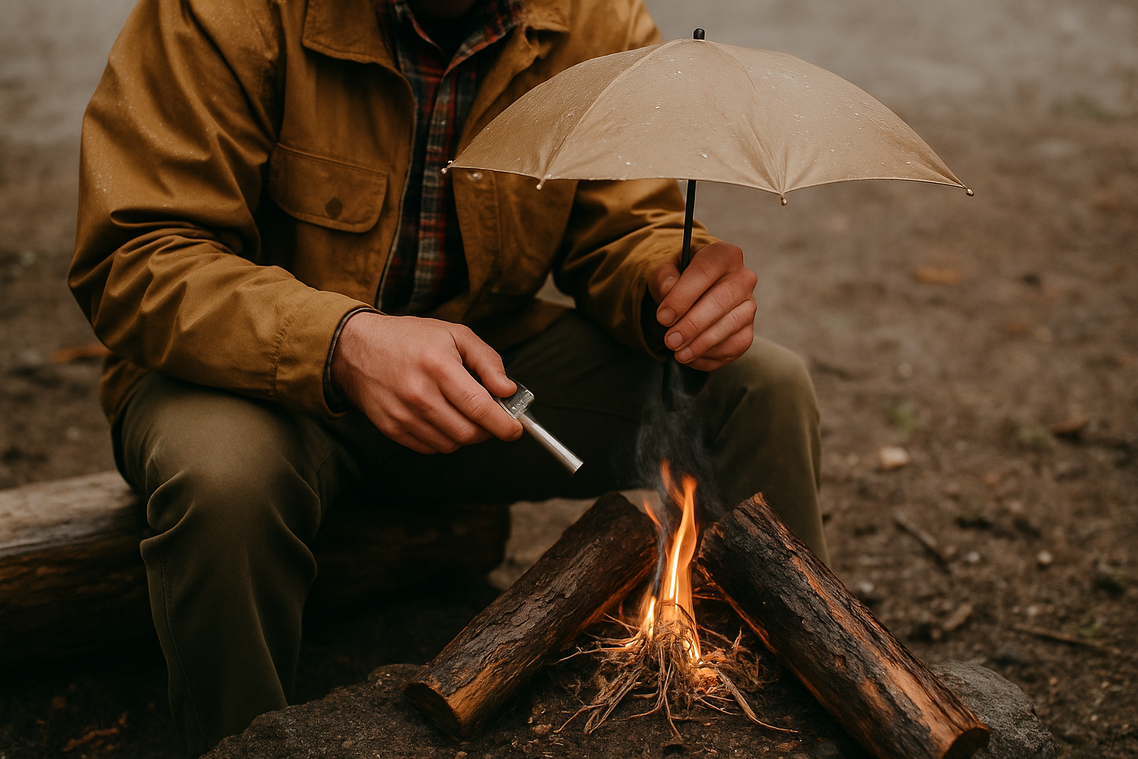
Before striking a spark, collect all three tiers of fuel. Fire is a progression, not a single event.
1. Tinder (The Spark Catcher)
Tinder is fine, highly combustible material that catches a spark. Birch bark contains natural oils that burn even when damp. Fatwood—resin-rich pine heartwood—ignites quickly due to concentrated sap. You can also shave dry inner wood into feather-like curls. In a pinch, cotton balls coated in petroleum jelly work well (a classic survival trick for a reason).
2. Kindling (The Flame Builder)
Kindling consists of pencil-lead to thumb-sized sticks that bridge the gap between tinder and larger fuel. If outer wood is wet, use batoning—splitting logs with a knife and baton—to expose the dry core. This step clarifies a common misconception: fire doesn’t fail from bad sparks; it fails from poor preparation.
3. Fuel Wood (The Sustainer)
Fuel wood includes wrist-sized logs and larger pieces that maintain heat. Gather at least three times more than you think you’ll need. Fires consume optimism quickly (experience teaches that lesson fast).
Building the Fire Lay: Structure is Everything
When it comes to fire craft, structure determines success. According to the U.S. Forest Service, proper airflow is one of the top factors influencing ignition efficiency and coal production (USFS Fire Science). In other words, how you stack it matters as much as what you burn.
The Teepee
The teepee lay forms a cone with tinder in the center and kindling arranged around it like spokes meeting at the top. Light it from the bottom—heat rises, preheating the upper sticks and accelerating combustion (a simple physics win). This structure creates a fast, hot flame, making it ideal for building a fire in wet conditions when you need to dry damp kindling quickly. Think of it as the campfire equivalent of turning the stove to high.
The Log Cabin
The log cabin lay layers fuel wood in alternating squares around a central tinder bundle. Each layer increases stability and airflow, producing a steady burn and a lasting coal bed. Research on combustion airflow shows cross-ventilation improves burn consistency (Combustion Institute). If you want coals for cooking, this is your foundation.
The Lean-To
In windy conditions, use a large log as a windbreak “backbone.” Lean smaller kindling against it, placing tinder at the base on the sheltered side. This reduces oxygen spikes that can snuff weak flames (yes, too much wind can kill a spark).
Pro tip: Pair your fire skills with foraging basics identifying edible wild plants (https://anglehozary.com/foraging-basics-identifying-edible-wild-plants/) to turn heat into a hot meal.
The Ferrocerium Rod
A ferrocerium rod is a metal alloy that throws sparks at about 3,000°C (5,430°F). That temperature matters because marginal tinder—slightly damp grass, scraped bark, fine wood shavings—needs intense heat to ignite. Scrape with the spine of a knife at a 45-degree angle and pull the rod back to control spark direction (yes, direction matters). This is crucial when building a fire in wet conditions.
The Simple Lighter
A disposable butane lighter is easy and fast. Press, flame, done. But cold temperatures reduce gas pressure, and moisture can block the wheel. Keep it dry in a sealed bag and warm it in a pocket before use.
Waterproof/Stormproof Matches
- Waterproof matches resist brief moisture.
- Stormproof matches burn through wind and rain, thanks to a thicker chemical coating that sustains combustion.
Carry redundancies; ignition is survival’s first gate. Test your tools before every trip outdoors. Stay prepared always.
From Spark to Sustained Flame
You now hold the full method for building a fire in wet conditions. Think of it like assembling a house in a storm: without a foundation, everything collapses. The real enemy isn’t rain; it’s improvisation. When you clear ground, lay a dry platform, and split logs to reach their dry heartwood, you’re peeling back soaked layers like a rain jacket to find the warm body beneath. Preparation is your shelter. Some argue skill alone is enough. It isn’t. Practice now, on the next gray afternoon, and turn theory into muscle memory. Before emergencies demand it.
Keep the Flame Alive on Every Adventure
You set out to master essential wilderness skills—and now you understand what it really takes to stay prepared when conditions turn against you. From smart gear choices to sharpening your navigation instincts and building a fire in wet conditions, you’re no longer guessing. You’re equipped with practical knowledge that can make the difference between comfort and crisis.
The real challenge outdoors isn’t the trail you expect—it’s the one you don’t. Cold rain, fading light, damp timber, and dropping temperatures test your preparation fast. When your fire won’t catch or your route feels uncertain, small mistakes can become big problems.
That’s why sharpening your backcountry skills now matters. Don’t wait for a high-stakes moment to wish you’d practiced more.
If you’re ready to explore smarter, travel safer, and handle the wild with confidence, dive deeper into our expert field guides and gear breakdowns. Join thousands of outdoor enthusiasts who rely on our trusted insights to stay prepared. Start refining your survival skills today—because the wilderness doesn’t wait.
 Head of Gear Intelligence & Field Testing
Bertha Mayonativers writes the kind of backcountry concepts and gear content that people actually send to each other. Not because it's flashy or controversial, but because it's the sort of thing where you read it and immediately think of three people who need to see it. Bertha has a talent for identifying the questions that a lot of people have but haven't quite figured out how to articulate yet — and then answering them properly.
They covers a lot of ground: Backcountry Concepts and Gear, Angle-Ready Wilderness Navigation, Campfire Recipes and Survival Skills, and plenty of adjacent territory that doesn't always get treated with the same seriousness. The consistency across all of it is a certain kind of respect for the reader. Bertha doesn't assume people are stupid, and they doesn't assume they know everything either. They writes for someone who is genuinely trying to figure something out — because that's usually who's actually reading. That assumption shapes everything from how they structures an explanation to how much background they includes before getting to the point.
Beyond the practical stuff, there's something in Bertha's writing that reflects a real investment in the subject — not performed enthusiasm, but the kind of sustained interest that produces insight over time. They has been paying attention to backcountry concepts and gear long enough that they notices things a more casual observer would miss. That depth shows up in the work in ways that are hard to fake.
Head of Gear Intelligence & Field Testing
Bertha Mayonativers writes the kind of backcountry concepts and gear content that people actually send to each other. Not because it's flashy or controversial, but because it's the sort of thing where you read it and immediately think of three people who need to see it. Bertha has a talent for identifying the questions that a lot of people have but haven't quite figured out how to articulate yet — and then answering them properly.
They covers a lot of ground: Backcountry Concepts and Gear, Angle-Ready Wilderness Navigation, Campfire Recipes and Survival Skills, and plenty of adjacent territory that doesn't always get treated with the same seriousness. The consistency across all of it is a certain kind of respect for the reader. Bertha doesn't assume people are stupid, and they doesn't assume they know everything either. They writes for someone who is genuinely trying to figure something out — because that's usually who's actually reading. That assumption shapes everything from how they structures an explanation to how much background they includes before getting to the point.
Beyond the practical stuff, there's something in Bertha's writing that reflects a real investment in the subject — not performed enthusiasm, but the kind of sustained interest that produces insight over time. They has been paying attention to backcountry concepts and gear long enough that they notices things a more casual observer would miss. That depth shows up in the work in ways that are hard to fake.