
The wilderness provides a bounty of nutrition—but only for those who know how to look. If you’re here, you want a safe, reliable way to begin foraging without risking a dangerous mistake. Misidentifying a wild plant can mean far more than a bad meal; it can have serious, even fatal, consequences. This guide gives you a safety-first foundation, cutting through guesswork and folklore to focus on proven rules and practical skills. You’ll learn the non-negotiable principles of foraging, how to perform the Universal Edibility Test in a true survival scenario, and how to confidently identify five of the most common and safest wild edibles.
The Bedrock Rules of Safe Foraging
Foraging sounds simple—find a plant, eat the plant. In reality, safety hinges on four clear rules. Let’s break them down.
-
The 100% Certainty Mandate. This rule means absolute identification—no guessing, no “it looks close enough.” Many toxic plants mimic edible ones; hemlock, for example, resembles wild carrot but can be lethal (CDC). If there is any doubt, there is no doubt. Proper edible wild plants identification requires confirming leaf shape, stem texture, smell, habitat, and season. Miss one detail, and you’re gambling.
-
Location Matters. Even safe plants become unsafe in contaminated soil. Roadsides often contain heavy metals from vehicle emissions, while industrial zones may have chemical runoff (EPA). Similarly, sprayed fields can carry pesticide residue. In short, a clean species in a dirty place is still a bad choice.
-
Know Your Plant Parts. Edible doesn’t mean entirely edible. Pokeweed is a classic example: young shoots can be eaten when properly boiled, yet its roots and mature berries are toxic (FDA). One plant, different rules.
-
The Law of Averages. Finally, start small. Even known edibles can cause individual reactions. A modest first taste lets your body vote before you commit.
Five Widespread Edibles for the Beginner Forager
If you’re new to foraging, start with plants that are common, distinctive, and forgiving. Think of this as edible wild plants identification 101: clear features, minimal lookalikes, and simple prep.
1. Dandelion (Taraxacum officinale)
Dandelion vs. lookalike cat’s ear? The giveaway is one single flower per hollow, unbranched stalk. Leaves are deeply toothed (like a lion’s jaw) and grow in a basal rosette.
Edible parts: leaves, flowers, roots.
Young leaves are less bitter in salads; older ones shine sautéed. Flowers can be frittered, and roots roasted as a coffee substitute.
2. Broadleaf Plantain (Plantago major)
Plantain vs. random lawn weed? Look for broad leaves with distinct parallel veins running from base to tip and a low rosette hugging the ground.
Common in compacted soil and lawns, it’s often underfoot.
Edible parts: young leaves and seeds.
Leaves are best before they get fibrous; steam or chop finely. Seeds can be sprinkled into porridge.
3. Cattail (Typha latifolia)
Cattail vs. iris? Cattail has the unmistakable brown, sausage-like flower spike and long, flat leaves.
Often called the “supermarket of the swamp,” it offers food across seasons:
- Spring shoots (raw or sautéed)
- Summer pollen (flour supplement)
- Fall/winter roots (starchy when cooked)
Few plants provide that range.
4. Stinging Nettle (Urtica dioica)
Nettle vs. mint? Both have serrated leaves and square stems, but nettle’s tiny stinging hairs (trichomes) are the clincher. Wear gloves when harvesting.
The sting disappears completely once cooked or dried. Nutritionally dense—rich in iron and vitamins A and C—it rivals spinach (and arguably outperforms it in wild flavor).
5. Chickweed (Stellaria media)
Chickweed vs. spurge? Snap the stem. Chickweed has a stretchy inner core and a single line of fine hairs along one side.
Tender and mild, it’s excellent raw in salads or lightly wilted.
As you build confidence, pair your finds with simple trail meals like diy campfire bread simple recipes without ovens for a backcountry feast that feels almost unfairly resourceful.
Critical Alert: Common Plants and Their Toxic Twins
In the wild, lookalikes can be lethal. During edible wild plants identification, your senses are your first line of defense.
Wild Carrot vs. Poison Hemlock: Crush the leaves. Wild Carrot (Queen Anne’s Lace) smells fresh and carroty, its stem bristly under your fingers. Poison Hemlock feels slick and hairless, marked with bruised-purple splotches. Its odor is rank and mousy. Hemlock is deadly poisonous—ingestion can cause respiratory failure (CDC).
Wild Grapes vs. Moonseed: Wild grapes climb with forked tendrils curling like springs, bearing tight clusters of sweet, familiar fruit. Slice one open—multiple round seeds. Moonseed lacks tendrils, and inside the dark berry rests a single crescent-shaped seed like a tiny moon. That single seed signals danger; Moonseed is toxic.
- When unsure, stop. One mistake can outweigh a hundred safe finds.
False Morels vs. True Morels: True morels are honeycombed and completely hollow, cap fused to stem. False morels feel lobed and irregular; cut them open to find cottony folds or chambers—never truly hollow (North American Mycological Association).
The Universal Edibility Test: A Survival Last Resort
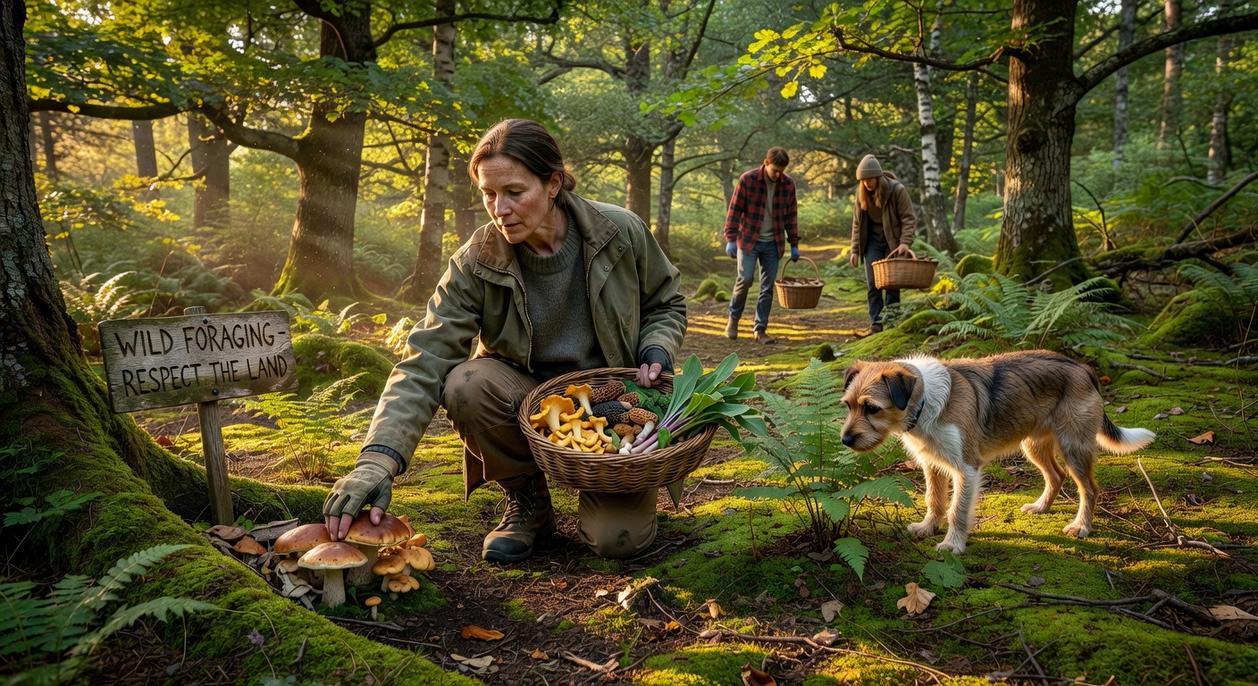
Disclaimer: This is a slow, multi-step process meant for dire emergencies only. It never replaces positive edible wild plants identification, which is always safer and more reliable.
The Process
First, separate the plant into parts—leaves, stems, roots, flowers—because one part may be toxic while another is not. Next, test for contact poisoning by placing a small piece on your inner forearm for 15 minutes. If no reaction occurs, touch a piece to your lips, then tongue, then chew without swallowing. Finally, swallow a tiny amount and wait several hours.
Research shows many toxic plants cause immediate irritation before systemic symptoms (CDC). At any burning, itching, or nausea, stop immediately. The principle is simple: introduce the smallest amount possible, then wait. In survival, patience prevents poisoning.
Your Journey from Novice to Knowledgeable Forager
Mastering edible wild plants identification isn’t about memorizing hundreds of species—it’s about being absolutely certain of a trusted few. The wild offers both nourishment and danger, and the line between them is careful, confident identification. If you’ve felt unsure where to begin, start small. Choose one plant—like the dandelion—and observe it closely in your yard or park. Build certainty first. Confidence grows one plant at a time.