Ever start a hike thinking you’re on a gentle trail, only to find yourself gasping halfway up a steep incline? I know the feeling. That’s why I’m here to help you read topographic maps like a pro.
With years of wilderness navigation under my belt, I’ve learned that understanding elevation maps is key for planning smart, safe adventures. This guide will transform your approach to the backcountry. Imagine confidently knowing a trail’s difficulty and uncovering hidden gems just by glancing at a map.
Stick around, and gain the skills to make every trek a thrilling discovery. Ready for the adventure?
Elevation Maps: Your Secret Backcountry Weapon
Let’s get one thing straight. Elevation maps aren’t just for showing hills. They’re your best backcountry tool.
Why? Because they keep you safe and help plan your adventure.
Realistic Planning
When you read topographic maps, you’re not just looking at lines. You’re planning your day. Ever tried a 5-mile walk?
Easy, right? Now, imagine adding 2,000 feet of elevation gain. Suddenly, it’s a whole different beast.
Knowing the elevation helps you prepare for what’s ahead. You can avoid overexertion and estimate your hiking time better. It’s like knowing your limits before you even start.
Hazard avoidance is another biggie. Elevation maps can be lifesavers. They highlight steep drop-offs and avalanche-prone slopes.
Those maps show the slope angles. And let’s not forget about flash floods. Low-lying riverbeds are dangerous, and maps help you steer clear.
So, why risk it?
But it’s not all about avoiding trouble. These maps are gold for resource finding too. You can spot saddles for potential campsites or high points for stunning views.
And valleys? They’re often where you find water sources. Who doesn’t love a good stream after a hard trek?
Pro tip: Always carry a compass. It’s easy to get turned around out there. Mastering the basics of compass navigation is key. Trust me, when you’re miles from anywhere, you’ll be glad you did.
Elevation maps aren’t just paper with squiggly lines. They’re your guide to smarter, safer adventures. So, next time you’re out there, make sure you’re prepared.
Decoding the Squiggly Lines: A Guide to Topography
Let’s jump into the world of topographic maps. These maps are like the secret language of the earth, whispering its secrets if you know how to listen. When you learn to read topographic maps, you start seeing the world differently (and maybe avoid hiking nightmares).
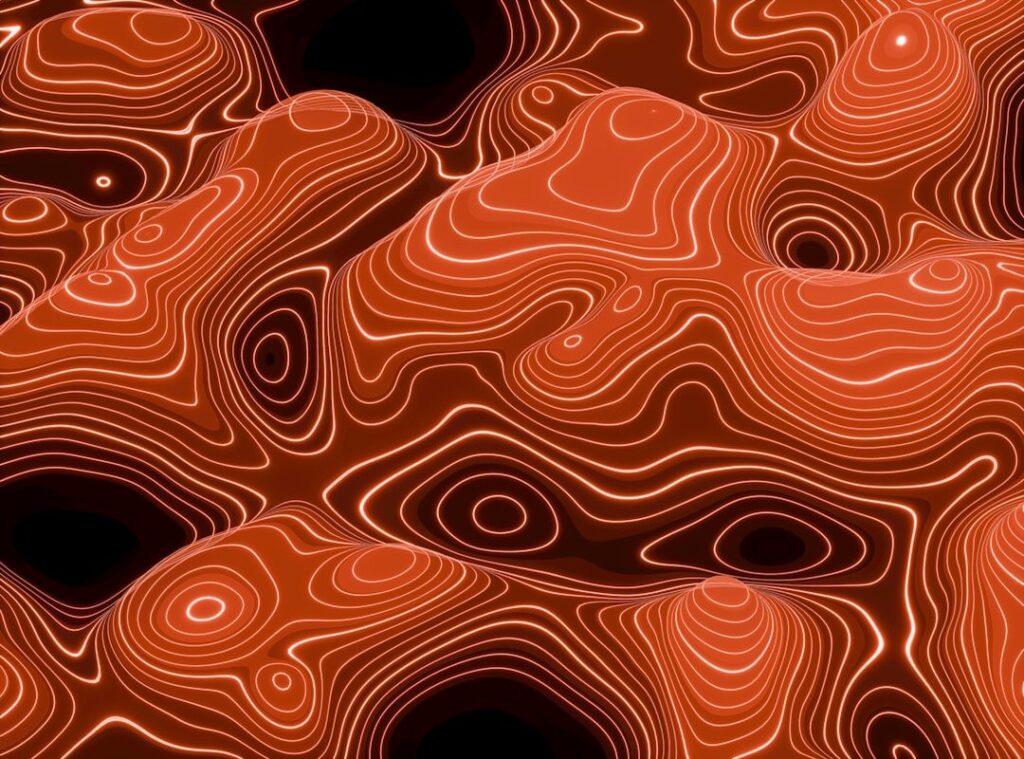
First, let’s tackle those mysterious contour lines. Imagine slicing a mountain into even layers, like a cake, and tracing each slice. That’s what contour lines do.
They connect points of equal elevation, creating a visual representation of the land’s shape. The closer the lines, the steeper the terrain. It’s like a secret message saying, “Get ready to climb!” If they’re spaced out, you’re looking at flatter ground.
Easy walking, right?
Now, the contour interval is key (not to sound dramatic, but it is). This is the vertical distance between each line. You can find it in the map’s legend, and it tells you how much elevation change each line represents.
It’s important because it helps you understand how steep a hill is or how tall a mountain stands.
Spacing between lines? It reveals the lay of the land. Lines packed tightly together scream steep slope.
If you’re not in the mood for a workout, avoid those areas. When lines are far apart, the terrain is flat or gently rolling. Perfect for a leisurely stroll without breaking a sweat.
V-shapes, pointing uphill, mark valleys or drainages. U-shapes, pointing downhill, hint at ridges. And those hourglass shapes?
Identifying features on these maps is like solving a fun puzzle. Circles indicate hills or peaks. Simple, right?
They’re saddles, the low points between peaks.
If you’re curious and want to dive deeper, you can read topographic maps for more tips. It’s like learning a new language, but for navigating the wild. So grab a map, head outside, and start decoding those squiggly lines.
Trust me, once you get the hang of it, nature starts talking back.
From Paper to Pixels: Navigating Elevation
In the age of smartphones, digital tools are reshaping how we explore backcountry landscapes. Sure, paper maps have their charm and reliability (never running out of batteries), but let’s face it, digital maps are way more convenient. You can quickly read topographic maps on your phone, zoom in and out, and get elevation data at your fingertips.
Have you tried Gaia GPS? It’s like having a mountain guide in your pocket, providing full elevation profiles. Before heading out, I always check my total ascent and descent.
Trust me, knowing what you’re in for can make all the difference between a good day and a grueling one. And let’s not forget CalTopo. It’s perfect for those who love planning every detail (I’m guilty as charged).
It allows you to create custom routes with precise elevation data.
Then there’s AllTrails. While it requires a pro subscription for some features, its elevation tracking is top-notch. One pro tip: before you lose service, download your maps and check your planned route’s elevation profile.
Knowing the ups and downs ahead prepares you mentally and physically for the day’s challenges.
For those who crave more advanced tactics, don’t miss these orienteering tips for advanced hikers. It’s a game-changer.
Digital tools make backcountry navigation more accessible and fast. And while paper maps still have their place, the convenience and depth of digital tools can’t be ignored. Are you ready to embrace the digital age?
Or will you cling to the past? Either way, adventure awaits.
Plotting Your Path: Day Hike Map Mastery
Planning a day hike isn’t just slapping on some boots. It’s all about plan. First things first: choose a destination.
Suppose you’re eyeing that distant peak or tranquil lake on your map. It’s your Everest (but, you know, doable in a day). That’s step one.
You should. This is where we read topographic maps like pros.
Now, trace your route. With your finger or pen, follow the trail on the map. Feel like a cartographer yet?
Next, let’s tackle those contour lines. Count them up and remember, they’re not just decoration. They dictate elevation gain.
If each line equals 100 feet and you cross 10, well, you do the math (it’s 1,000 feet).
Then, assess the terrain. Where the lines are tight, brace yourself. You’re in for a steep climb.
But if they’re spaced out, it’s time to relax. Use these moments to catch your breath and soak in the surroundings.
And finally, always cross-reference with your map’s legend. Helps avoid those “I think we’re lost” moments. Pro tip: bring snacks (trust me, you’ll thank me at the summit).
Now, get out there and conquer that trail!
Master the Outdoors Like Never Before
Understanding elevation maps changes the game. You go from following trails to confidently leading your own path. No more guessing what’s over the next hill.
The risk of misjudging terrain loses its grip when you can read topographic maps and get through wisely. Want safer, richer adventures? Start now.
Pull out a map of a local park this week. Practice spotting a ridge or calculating the climb to a viewpoint. Your future adventures will thank you.
Ready to transform your outdoor experiences? Dive into this skill and watch your confidence soar. Your next adventure awaits.
Don’t wait. Start today.
 Wilderness Navigation & Survival Content Strategist
Diane Khanatibo writes the kind of backcountry concepts and gear content that people actually send to each other. Not because it's flashy or controversial, but because it's the sort of thing where you read it and immediately think of three people who need to see it. Diane has a talent for identifying the questions that a lot of people have but haven't quite figured out how to articulate yet — and then answering them properly.
They covers a lot of ground: Backcountry Concepts and Gear, Angle-Ready Wilderness Navigation, and plenty of adjacent territory that doesn't always get treated with the same seriousness. The consistency across all of it is a certain kind of respect for the reader. Diane doesn't assume people are stupid, and they doesn't assume they know everything either. They writes for someone who is genuinely trying to figure something out — because that's usually who's actually reading. That assumption shapes everything from how they structures an explanation to how much background they includes before getting to the point.
Beyond the practical stuff, there's something in Diane's writing that reflects a real investment in the subject — not performed enthusiasm, but the kind of sustained interest that produces insight over time. They has been paying attention to backcountry concepts and gear long enough that they notices things a more casual observer would miss. That depth shows up in the work in ways that are hard to fake.
Wilderness Navigation & Survival Content Strategist
Diane Khanatibo writes the kind of backcountry concepts and gear content that people actually send to each other. Not because it's flashy or controversial, but because it's the sort of thing where you read it and immediately think of three people who need to see it. Diane has a talent for identifying the questions that a lot of people have but haven't quite figured out how to articulate yet — and then answering them properly.
They covers a lot of ground: Backcountry Concepts and Gear, Angle-Ready Wilderness Navigation, and plenty of adjacent territory that doesn't always get treated with the same seriousness. The consistency across all of it is a certain kind of respect for the reader. Diane doesn't assume people are stupid, and they doesn't assume they know everything either. They writes for someone who is genuinely trying to figure something out — because that's usually who's actually reading. That assumption shapes everything from how they structures an explanation to how much background they includes before getting to the point.
Beyond the practical stuff, there's something in Diane's writing that reflects a real investment in the subject — not performed enthusiasm, but the kind of sustained interest that produces insight over time. They has been paying attention to backcountry concepts and gear long enough that they notices things a more casual observer would miss. That depth shows up in the work in ways that are hard to fake.